
An HS Code (Harmonized System code) is a 6–10 digit number that classifies every product traded internationally. The first 6 digits are universal worldwide, while additional digits vary by country—the USA uses a 10-digit HTS code, the EU uses a 10-digit TARIC code, and China uses a 8–10 digit code. Getting your HS code right determines your import duty rate, and misclassification is the #1 cause of unexpected duty bills, customs audits, and shipment delays.
This guide explains how HS codes work, how to find the correct code for your product, the costly consequences of misclassification, and how China, US, and EU codes differ. Use it to classify your imports correctly and avoid paying more duty than legally required.
What Is an HS Code and How Does It Work?
The Harmonized System (HS) is a standardized product classification system developed by the World Customs Organization (WCO) and used by over 200 countries. It organizes goods into 21 sections and 97 chapters, covering everything from live animals (Chapter 01) to works of art (Chapter 97).
The HS code structure breaks down as follows:
| Digits | Level | Example (Bluetooth Speaker) |
|---|---|---|
| 85 | Chapter (electrical machinery) | 85 |
| 8518 | Heading (loudspeakers) | 8518 |
| 8518.21 | Subheading (single loudspeaker) | 8518.21 |
| 8518.21.00 | 6-digit universal code | 8518.21.00 |
| 8518.21.00.00 | 10-digit US HTS code | 8518.21.00.00 |
The first 6 digits are identical in every country. Only the final 2–4 digits differ based on the importing country’s national tariff schedule. This means your product’s core HS code is the same whether you import to the USA, EU, UK, or Australia—only the duty rate changes.
How to Find the Correct HS Code for Your Product
Finding the correct HS code requires knowing your product’s material, function, and intended use. Here is a step-by-step process:
- Identify the chapter: Determine which of the 97 chapters your product falls under based on material and function (e.g., electronics → Chapter 85, furniture → Chapter 94).
- Narrow to the heading and subheading: Drill down using the official tariff schedule. For US imports, use the USITC HTS search tool at hts.usitc.gov.
- Read the classification notes: Each chapter has legal notes that define what is included and excluded. These notes often override the plain meaning of a product name.
- Confirm the final country code: Extend the 6-digit code to the importing country’s full tariff code (10 digits for USA, 10 for EU).
- Verify with an expert: Your freight forwarder or customs broker can confirm your classification and estimate the duty rate before you ship.
For complex products, your DDP freight forwarder classifies the HS code and calculates the full duty into your shipping quote—so you know the exact landed cost before goods leave China.
China vs US vs EU HS Code Differences
While the first 6 digits are universal, the importing country determines the final code and duty rate. Here is how the three major markets differ:
| Market | Code System | Length | Duty Rate Reference |
|---|---|---|---|
| China (export) | Chinese HS code | 8–10 digits | Used for export declaration (mostly duty-free for exports) |
| USA (import) | HTS code | 10 digits | USITC database + Section 301 tariff lists |
| EU (import) | TARIC code | 10 digits | EU TARIC database + VAT & anti-dumping duties |
| UK (import) | UK Global Tariff | 10 digits | UK Trade Tariff tool (post-Brexit) |
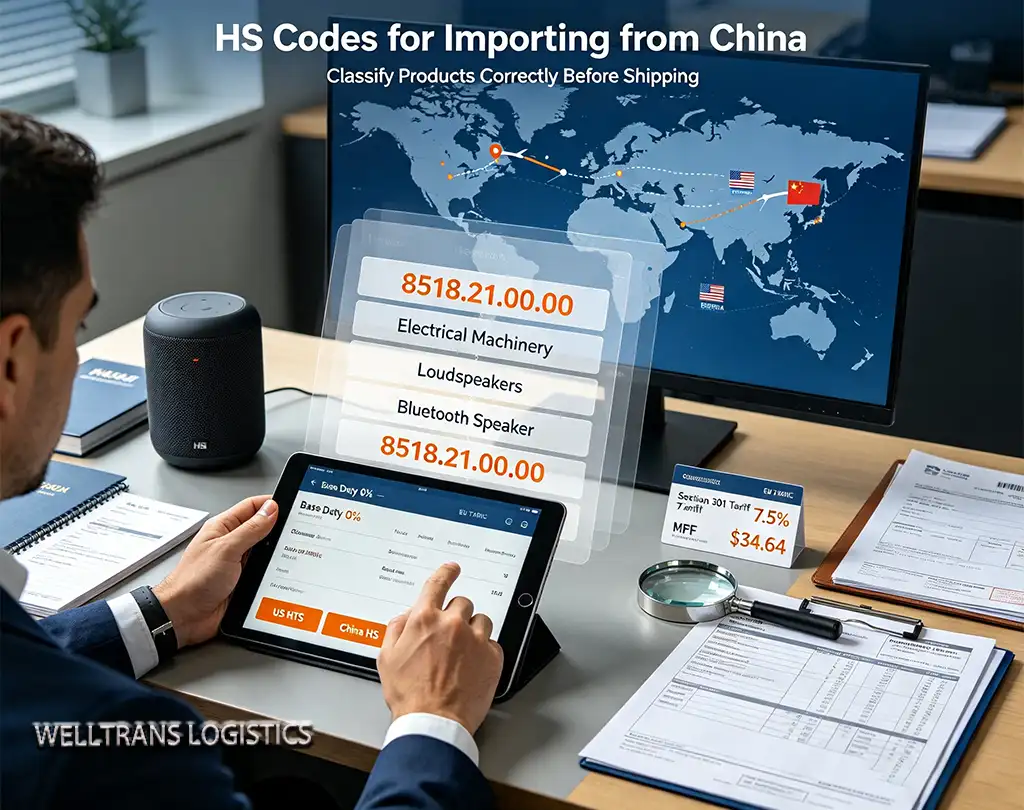
For example, a Bluetooth speaker has the universal 6-digit code 8518.21, but the US HTS code is 8518.21.00.00 with a base duty of 0% plus a 7.5% Section 301 tariff, while the EU TARIC code may carry a 2.5% duty plus VAT. Always classify using the importing country’s tariff schedule, not China’s export code.
The Consequences of HS Code Misclassification
Misclassifying your product under the wrong HS code triggers serious consequences:
- Unexpected duty bills: If customs reclassifies your goods into a higher-duty category, you receive a retroactive duty bill—sometimes months after the shipment cleared.
- Customs audits: A pattern of misclassification flags your importer record for audit, increasing scrutiny on all future shipments.
- Penalties and fines: US Customs can assess penalties up to 4× the underpaid duty for negligence, and higher for fraud.
- Shipment holds and delays: When the HS code on your invoice doesn’t match the product, customs holds the shipment for inspection—adding 3–14 days and $200–$500 in exam fees.
- Overpaying duty: Classifying under the wrong (higher) code means you legally overpay. Many importers discover they could have used a lower-duty classification and request refunds.
Pro tip: Products with dual uses (e.g., a camera that also records audio) may fall under multiple HS codes. In these cases, the classification rules determine the correct code based on the product’s “essential character” or “principal function.” When in doubt, get a binding ruling from customs or have your forwarder verify.
HS Codes and Section 301 Tariffs on Chinese Goods
For US importers, the HS code also determines whether your product is subject to additional Section 301 tariffs of 7.5% or 25% on Chinese goods. These tariffs are applied on top of the normal import duty and are tied to specific HS codes on the USTR lists.
Here is how the total US duty is calculated:
| Duty Layer | Rate | Example (Bluetooth Speaker, $10,000 value) |
|---|---|---|
| Normal import duty (MFN) | 0% (8518.21 is duty-free) | $0 |
| Section 301 tariff | 7.5% (List 4B) | $750 |
| Merchandise Processing Fee (MPF) | 0.3464% (min $31) | $34.64 |
| Total US duties | — | $784.64 |
Your HS code classification directly determines this duty amount. Using DDP shipping means your forwarder calculates these duties into your quote and pays them on your behalf—eliminating surprise bills.
FAQ: HS Codes for Importing from China
What is the difference between an HS code and an HTS code?
HS codes are the universal 6-digit classification used by over 200 countries. HTS codes (Harmonized Tariff Schedule) are the USA’s 10-digit extension of the HS code. Every HTS code begins with the same 6-digit HS code, with 4 additional US-specific digits. The EU equivalent is called a TARIC code.How do I find the HS code for my product?
Identify your product’s chapter (based on material and function), drill down using the USITC HTS search tool (hts.usitc.gov) for US imports or the EU TARIC database for EU imports, and read the chapter’s legal notes. Your freight forwarder or customs broker can also classify your product and confirm the correct 10-digit code.What happens if I use the wrong HS code?
Using the wrong HS code triggers retroactive duty bills, customs audits, penalties up to 4× the underpaid duty, shipment holds (3–14 days), and $200–$500 in exam fees. If the code is lower than correct, you underpay and face penalties; if higher, you legally overpay and may be owed a refund.Does the HS code determine the Section 301 tariff on Chinese goods?
Yes. The Section 301 tariff (7.5% or 25%) on Chinese imports is tied to specific HS codes on the USTR lists. Your product’s HS code determines whether it’s subject to the additional tariff, which is applied on top of the normal import duty. DDP shipping calculates and includes this tariff in your quote.Are HS codes the same in every country?
The first 6 digits of an HS code are identical worldwide under the WCO harmonized system. Only the final 2–4 digits differ by importing country. So a Bluetooth speaker is 8518.21 everywhere, but the full code is 8518.21.00.00 in the USA and a slightly different 10-digit TARIC code in the EU.Can I change my product’s HS code after shipping?
You cannot change the HS code after the customs entry is filed without amending the entry, which requires a formal post-entry amendment or a customs ruling request. This is why verifying the correct HS code before shipping is critical. Your freight forwarder should confirm classification before goods leave China.
Get Your HS Code Classified Correctly
Stop guessing your product’s HS code. Welltrans Logistics classifies your goods, verifies the correct 10-digit HTS code, calculates all duties and tariffs, and builds the full cost into your shipping quote. Whether you need DDP shipping with duty paid upfront or help with ocean freight and customs brokerage, we ensure your classification is accurate before shipment.
Get your free HS code classification and shipping quote: Contact Welltrans Logistics or message us on WhatsApp for expert classification within 24 hours.
More resources: Shipping from China to USA · Air freight services · China warehouse & consolidation