
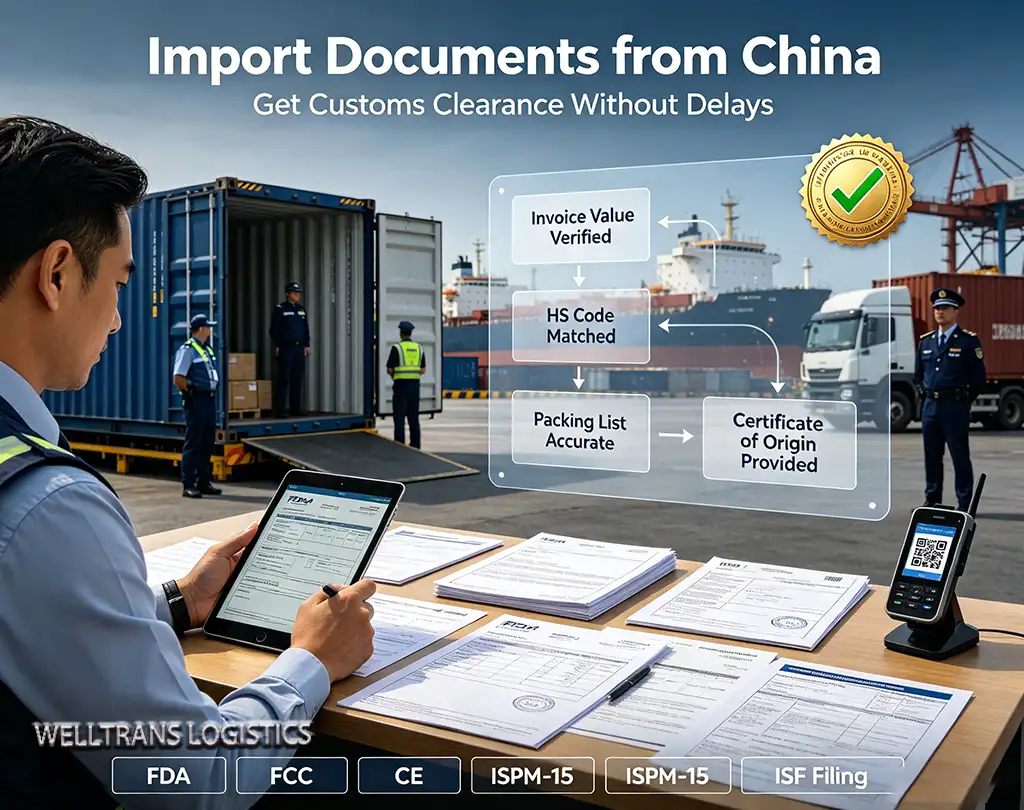
To import from China you need four core documents: a Commercial Invoice, Packing List, Bill of Lading (ocean) or Air Waybill (air), and Certificate of Origin. Depending on your product, you may also need special certificates such as CE marking, FDA registration, or FCC certification. Missing or incorrect documents are the #1 cause of customs clearance delays, adding 3–14 days to your shipment and triggering storage fees at the port.
This guide lists every document required to import from China, explains what each one does, and highlights the product-specific certificates that US, EU, and UK customs authorities demand. Use it as a pre-shipment checklist to ensure your next shipment clears customs without delays.
The 4 Core Import Documents from China
Every commercial shipment from China requires these four documents, regardless of the product or destination country:
| Document | Who Issues It | Purpose |
|---|---|---|
| Commercial Invoice | Chinese supplier/exporter | Declares goods value, buyer/seller, and payment terms. Customs uses it to calculate duties. |
| Packing List | Chinese supplier/exporter | Details weight, dimensions, carton count, and contents. Used for cargo handling and customs inspection. |
| Bill of Lading (B/L) | Ocean carrier/freight forwarder | Contract of carriage and proof of ownership for ocean freight. Required to release cargo at destination. |
| Certificate of Origin | China customs/chamber of commerce | Proves goods were manufactured in China. Needed for duty calculation and trade agreement benefits. |
For air freight, the Bill of Lading is replaced by an Air Waybill (AWB). For express courier shipments (DHL, FedEx, UPS), the carrier generates its own commercial invoice and waybill from the details you provide.
Commercial Invoice: The Most Important Document
The commercial invoice determines how much duty you pay, so accuracy is critical. It must include:
- Seller’s and buyer’s full names, addresses, and contact details
- Detailed product description (material, use, quantity, unit value)
- Total declared value and currency (usually USD)
- Incoterm (FOB, CIF, DDP, etc.)
- Country of origin (China)
- HS code for each product line
- Payment terms and signature of the exporter
Warning: Never under-declare invoice value to reduce duties. US Customs and Border Protection (CBP) cross-checks invoices against market prices and penalties for undervaluation can exceed 4× the underpaid duty. Your freight forwarder’s customs broker will verify your invoice is accurate before filing.
Packing List: The Cargo Roadmap
The packing list is what customs inspectors and warehouse teams use to locate specific items. A complete packing list includes:
- Carton number and total carton count
- Gross weight and net weight per carton
- Carton dimensions (length × width × height)
- Quantity and description of items per carton
- Marks and numbers matching the carton labels
For LCL and air shipments, the packing list must match the physical carton labels exactly. A mismatch between the packing list and actual cartons is one of the most common triggers for a physical customs inspection—which adds 3–7 days and $200–$500 in exam fees.
Product-Specific Certificates You May Need
Beyond the core four documents, regulated products require additional certificates. Shipping without them guarantees a customs hold or rejection:
| Product Type | Required Certificate | Destination Requirement |
|---|---|---|
| Electronics | FCC certification | USA — mandatory for wireless/electronic devices |
| Electrical goods | CE marking | EU & UK — mandatory for electronics |
| Food, drugs, medical devices | FDA registration | USA — mandatory for food and medical imports |
| Toys & children’s products | CPSC / ASTM F963 test report | USA — mandatory safety compliance |
| Wood packaging (pallets/crates) | ISPM-15 fumigation certificate | Global — mandatory heat treatment stamp |
| Apparel & textiles | Composition label + flammability test | USA/EU — fiber content and safety labels |
| Cosmetics | FDA / EU CPNP notification | USA/EU — product safety registration |
Your DDP freight forwarder verifies which certificates your products require before shipping and files them with the customs entry. This pre-shipment compliance check prevents holds at the destination port.
Additional Documents for Specific Shipping Scenarios
- Importer Security Filing (ISF / “10+2”): Required by US Customs for all ocean imports. Must be filed at least 24 hours before vessel loading. Your freight forwarder files this on your behalf.
- Power of Attorney (POA): Authorizes your customs broker to clear goods on your behalf. Required once, then valid for future shipments.
- Letter of Credit (L/C): If your payment terms use a letter of credit, the bank requires documents to match the L/C terms exactly—including invoice wording, dates, and quantities. Any discrepancy causes payment delays.
- Insurance Certificate: Proof of cargo insurance coverage. Standard coverage is 0.1–0.5% of invoice value.
- Import License / Permit: Required for regulated categories such as firearms, certain chemicals, and agricultural products.
Common Document Mistakes That Delay Customs
- Vague product descriptions: Writing “gift” or “samples” instead of a specific description triggers automatic inspection. Use the exact material, function, and HS code.
- Invoice value mismatch: If the commercial invoice doesn’t match the packing list quantities or the declared value looks too low, customs holds the shipment for valuation review.
- Missing Certificate of Origin: Without it, customs may apply the highest duty rate or reject the entry entirely for trade-preference claims.
- Incorrect HS code: The HS code on your invoice must match the actual product. Mismatches trigger reclassification, additional duties, and delays.
- Wood packaging without ISPM-15: Unstamped wood pallets and crates are rejected at destination ports in most countries, forcing fumigation or destruction of packaging.
How DDP Shipping Simplifies Import Documents
The biggest advantage of DDP shipping from China is that your freight forwarder prepares, verifies, and files all import documents on your behalf. You provide the basic product details; the forwarder handles:
- Commercial invoice preparation and duty classification
- ISF filing with US Customs
- Certificate of Origin application
- Customs entry and clearance
- Product compliance verification (CE, FCC, FDA)
This eliminates the document errors that cause 80% of customs delays and means your shipment clears without you ever dealing with customs paperwork directly. Learn more about how DDP works in our complete DDP guide or explore shipping from China to USA for country-specific requirements.
FAQ: Import Documents from China
What are the 4 core documents needed to import from China?
The four core import documents are: (1) Commercial Invoice — declares value and is used to calculate duties; (2) Packing List — details weight, dimensions, and contents; (3) Bill of Lading (ocean) or Air Waybill (air) — proof of carriage and ownership; and (4) Certificate of Origin — proves goods were manufactured in China.Do I need a customs broker to import from China?
Yes, US Customs requires a licensed customs broker for formal entries (shipments over $2,500). However, with DDP shipping, your freight forwarder’s broker handles all clearance documents and duties for you—so you never hire a separate broker. DDP includes this service in the shipping quote.What certificates do electronics need to import from China to the USA?
Electronics imported to the USA require FCC certification for wireless and electronic devices. If the product also has a power supply, it must comply with UL safety standards. Your freight forwarder or compliance specialist can confirm the exact certifications your specific product requires.Who prepares the import documents from China?
Your Chinese supplier prepares the Commercial Invoice and Packing List. The freight forwarder prepares the Bill of Lading, ISF filing, and Certificate of Origin. Under DDP shipping, the forwarder prepares and verifies all documents, ensuring accuracy before the shipment leaves China.What happens if my import documents are wrong?
Incorrect documents trigger customs holds, physical inspections, and delays of 3–14 days. You may pay $200–$500 in exam fees plus daily storage charges. In severe cases (under-declared value, missing certificates), customs may seize the goods or impose penalties up to 4× the underpaid duty.Do I need an Import Security Filing (ISF) for ocean shipments?
Yes. All ocean imports to the USA require an ISF (also called “10+2”) filed at least 24 hours before vessel loading. Failure to file results in a $5,000+ penalty per violation. DDP freight forwarders file the ISF on your behalf as part of their service.
Get Help Preparing Your Import Documents
Don’t let paperwork delay your shipment. Welltrans Logistics prepares and files all import documents—commercial invoice, ISF, Certificate of Origin, and customs entry—so your cargo clears customs without delays. Whether you need DDP shipping with full document handling or ocean freight with customs brokerage, we manage the paperwork from China to your door.
Get your free document-compliant shipping quote: Contact Welltrans Logistics or message us on WhatsApp for a customs-clear quote within 24 hours.
More resources: Shipping from China to USA · Air freight services · China warehouse & consolidation