
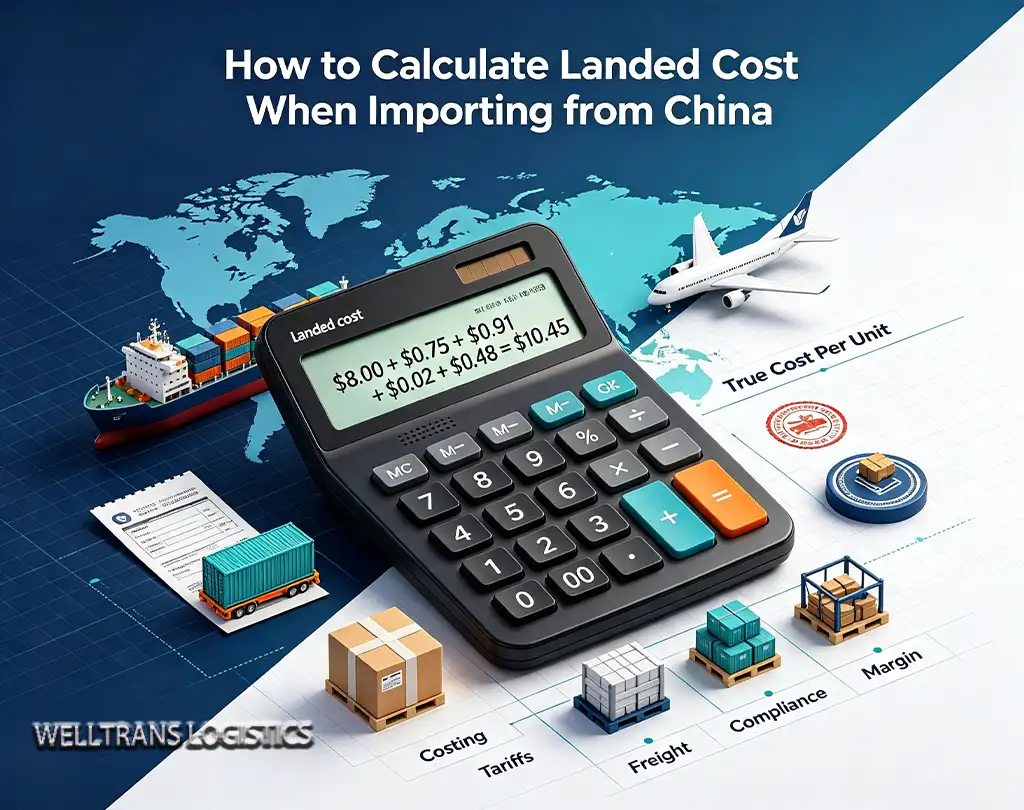
The landed cost formula is: Product Cost + Freight + Customs Duties + Insurance + Handling Fees = Total Landed Cost. For a typical shipment importing from China to the USA, landed cost adds 25–40% on top of the factory unit price—meaning a $10 product from a Chinese supplier actually costs you $12.50–$14.00 by the time it reaches your warehouse. Knowing how to calculate landed cost accurately is the single most important skill for importers, because it determines your true profit margin and prevents pricing surprises.
This guide walks through the exact landed cost formula, a real-world calculation example, the hidden costs most importers forget, and five strategies to reduce your total landed cost without sacrificing quality.
What Is Landed Cost?
Landed cost (also called total landed cost or true cost) is the total amount you pay to get a product from your Chinese supplier’s factory to your final destination—warehouse, store, or Amazon FBA center. It includes every cost along the way: manufacturing, packaging, international freight, customs duties, insurance, port handling, and last-mile delivery.
Many importers make the mistake of calculating profit margin based on the factory unit price alone. This leads to underpricing and shrinking margins. The landed cost is the number you must use when setting your retail price and calculating profitability.
The Landed Cost Formula
Here is the complete landed cost formula when importing from China:
Landed Cost = Product Cost + Freight Cost + Customs Duties + Insurance + Handling & Compliance Fees
Let’s break down each component:
| Component | What It Includes | Typical % of Landed Cost |
|---|---|---|
| Product Cost | Unit price from supplier, packaging, labeling | 60–75% |
| Freight Cost | Ocean or air freight from China to destination port | 10–20% |
| Customs Duties | Import duty + tariffs (e.g., Section 301) based on HS code | 5–25% |
| Insurance | Cargo insurance (0.1–0.5% of invoice value) | 0.5–1% |
| Handling & Compliance | Customs broker, ISF filing, port fees, last-mile delivery | 3–8% |
Real-World Landed Cost Calculation Example
Let’s calculate the landed cost for a real shipment. Imagine you are importing 1,000 units of Bluetooth speakers from Shenzhen, China to Los Angeles, USA by sea freight (LCL).
| Cost Item | Calculation | Amount |
|---|---|---|
| Product Cost | 1,000 units × $8.00/unit | $8,000 |
| FNSKU Labeling & Packaging | 1,000 units × $0.30/unit | $300 |
| Ocean Freight (LCL) | 5 CBM × $150/CBM | $750 |
| US Import Duty (3.9% HTS rate) | $8,000 × 3.9% | $312 |
| Section 301 Tariff (7.5%) | $8,000 × 7.5% | $600 |
| Merchandise Processing Fee (MPF) | 0.3464% × $8,000 (min $31, max $614) | $31 |
| Harbor Maintenance Fee (HMF) | 0.125% × $8,000 | $10 |
| Customs Broker Fee | Flat rate per entry | $175 |
| Cargo Insurance | 0.3% × $8,000 | $24 |
| Last-Mile Delivery (port to warehouse) | Trucking LAX port to local warehouse | $250 |
| Total Landed Cost | Sum of all above | $10,452 |
| Landed Cost Per Unit | $10,452 ÷ 1,000 | $10.45 |
In this example, the factory price was $8.00 per unit, but the true landed cost is $10.45 per unit—a 31% increase. If you sell this speaker for $24.99 on Amazon, your gross margin is $14.54 per unit, not $16.99. That difference of $2.45 per unit adds up to $2,450 across the full shipment.
Customs Duties: The Biggest Variable in Landed Cost
Customs duties are the most unpredictable component of landed cost because they depend on your product’s HS code (Harmonized System code) and current tariff policies. For US imports from China, you must account for two layers:
- Normal import duty (MFN rate): Typically 0–5% for most consumer goods, based on the HTS classification. Some products like electronics are duty-free.
- Section 301 tariffs: Additional 7.5%–25% on most Chinese imports, imposed by the US government. Your exact rate depends on whether your product is on List 1–4B.
To find your exact duty rate, look up your product’s 10-digit HTS code on the US International Trade Commission (USITC) database, then check the Section 301 tariff list. For a simpler approach, your freight forwarder can classify your HS code and calculate the total duty into a DDP shipping quote—so duties are paid upfront with no surprises.
Hidden Costs Importers Forget to Include
Beyond the obvious costs above, these hidden fees quietly inflate your landed cost if you don’t budget for them:
- Merchandise Processing Fee (MPF): 0.3464% of cargo value (min $31, max $614 per entry)—charged by US Customs on every formal entry.
- Harbor Maintenance Fee (HMF): 0.125% of cargo value on ocean imports—collected at port.
- Customs broker fee: $150–$300 per shipment if you’re not using DDP (which includes this).
- Demurrage & detention: $75–$200 per day if your container sits at port beyond the free period (typically 4–7 days).
- Warehousing & storage: If goods are held for inspection or await Amazon FBA appointment scheduling.
- Currency exchange fees: Your bank may charge 1–3% on international wire transfers to Chinese suppliers.
- Quality inspection: $200–$500 per shipment for third-party QC in China—worth every penny to avoid receiving defective goods.
How Incoterms Affect Your Landed Cost
The Incoterm you negotiate with your supplier determines which costs they cover and which fall on you. Here is how the four most common Incoterms impact landed cost:
| Incoterm | Supplier Pays | You Pay | Landed Cost Predictability |
|---|---|---|---|
| EXW (Ex Works) | Nothing beyond factory | Everything: pickup, export, freight, duties, delivery | Lowest — hardest to calculate |
| FOB (Free on Board) | Factory to departure port + export clearance | Ocean freight, duties, customs, delivery | Medium — you control freight & customs |
| CIF (Cost Insurance Freight) | Everything to destination port | Duties, customs clearance, delivery from port | Medium — freight is bundled, duties are not |
| DDP (Delivered Duty Paid) | Everything including duties & delivery | Nothing — just receive goods | Highest — single all-inclusive price |
DDP offers the most predictable landed cost because your freight forwarder bundles all duties, fees, and delivery into one quote. This is why many Amazon FBA sellers and first-time importers prefer DDP—you know your exact per-unit cost before goods ship. Learn more in our DDP shipping guide or explore shipping from China to USA options.
5 Strategies to Reduce Your Landed Cost
- Switch from air to sea freight for routine restocks: Sea freight is 40–60% cheaper than air. Use air only for urgent or lightweight shipments. Compare ocean freight vs air freight rates to find the right balance.
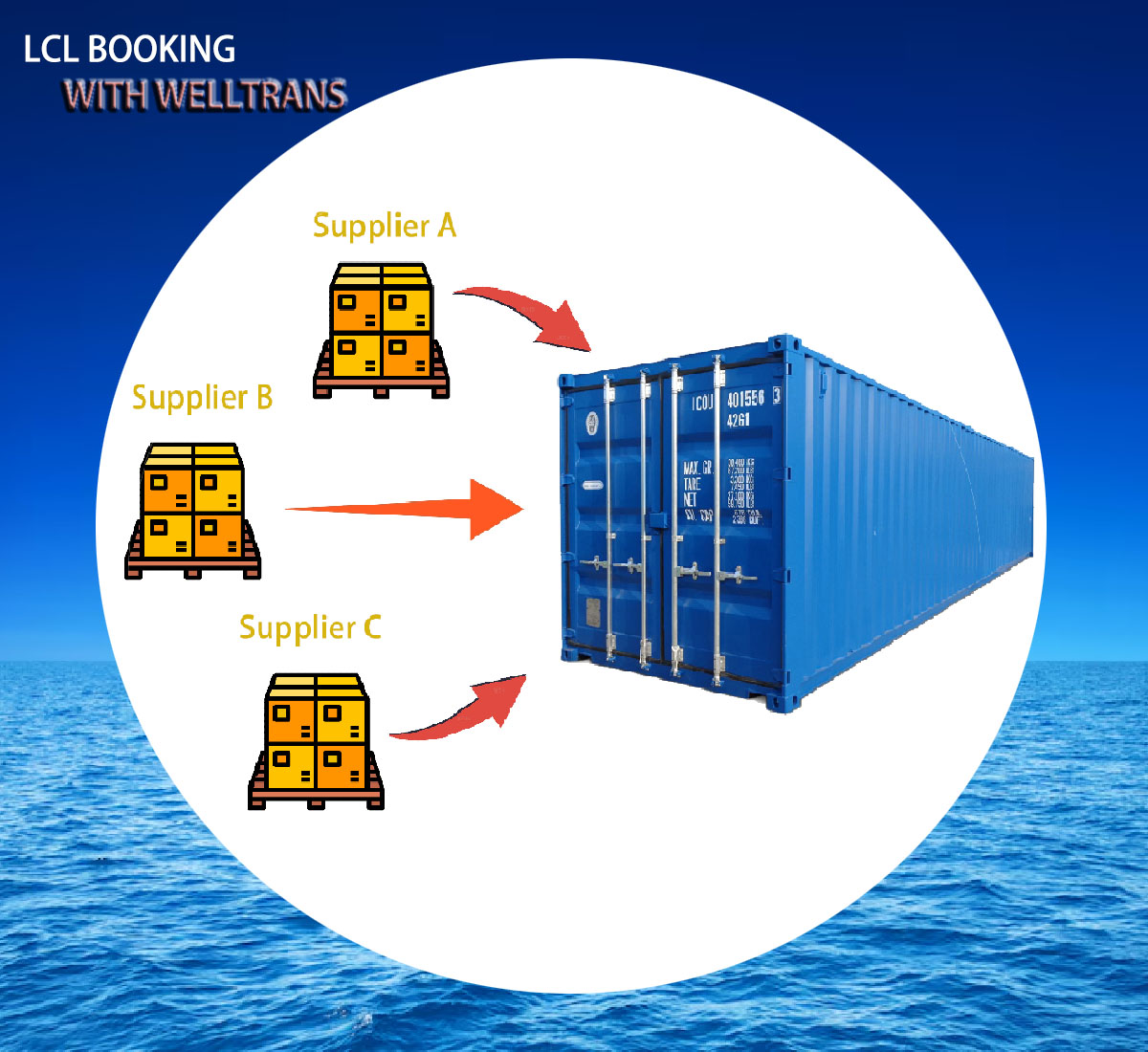
- Consolidate LCL shipments: Multiple small LCL shipments incur repeated customs broker fees and MPF charges. Consolidating into one FCL container reduces per-unit freight and handling costs by 20–35%.
- Use DDP to eliminate customs broker fees: DDP includes customs clearance—saving $150–$300 per shipment. It also eliminates demurrage risk because your forwarder pre-clears goods before arrival.
- Negotiate better Incoterms with suppliers: Ask your supplier to quote FOB instead of EXW, so you’re not paying for their markup on inland China transport. Or request DDP for full cost transparency.
- Verify your HS code classification: Many importers overpay duties because their product is classified under a higher-rate HS code. Have your forwarder or customs broker verify the correct 10-digit HTS code—you may find a lower-duty classification that’s still legally compliant.
FAQ: Calculating Landed Cost from China
What is the landed cost formula for importing from China?
Landed Cost = Product Cost + Freight + Customs Duties + Insurance + Handling Fees. Add up the factory unit price, international shipping, import duties (including Section 301 tariffs), cargo insurance, customs broker fees, MPF, HMF, and last-mile delivery to get your total landed cost per unit.How much does landed cost add to the product price from China?
Landed cost typically adds 25–40% on top of the factory unit price. For a $10 product, expect a landed cost of $12.50–$14.00. The exact percentage depends on shipping method, HS code duty rate, Section 301 tariff status, and Incoterm chosen.What is the difference between FOB price and landed cost?
FOB price covers the product cost plus delivery to the departure port in China. Landed cost includes the FOB price PLUS ocean freight, US import duties, customs clearance fees, insurance, and delivery to your final destination. Landed cost is always higher because it accounts for every cost to get goods to your door.Does DDP include all landed costs?
Yes. DDP (Delivered Duty Paid) includes product cost, freight, all import duties, tariffs, customs clearance, and last-mile delivery in a single price. This makes DDP the easiest way to know your exact landed cost upfront—no hidden fees or surprise duty bills.How do I find the correct duty rate for my product?
Look up your product’s 10-digit HTS code on the USITC website (hts.usitc.gov) to find the base import duty rate, then check if your product is subject to additional Section 301 tariffs (7.5% or 25%). Your freight forwarder or customs broker can also classify your product and calculate the total duty.What hidden costs should I include in landed cost?
Include the Merchandise Processing Fee (0.3464%, min $31), Harbor Maintenance Fee (0.125% for ocean), customs broker fees ($150–$300), demurrage risk ($75–$200/day), quality inspection ($200–$500), and currency exchange fees (1–3%). Forgetting these can understate your true landed cost by 5–10%.
Get Help Calculating Your Landed Cost
Stop guessing your true import costs. Welltrans Logistics provides itemized landed cost calculations with every quote—product cost, freight, duties, tariffs, and all fees broken down line by line. Whether you need DDP shipping for all-inclusive pricing or Amazon FBA delivery, we make sure your landed cost is transparent and predictable.
Get your free landed cost breakdown: Contact Welltrans Logistics or message us on WhatsApp for a detailed per-unit cost analysis within 24 hours.
More resources: Shipping from China to USA · Ocean freight · China warehouse & consolidation